

The Words You Use Shape The Business You Build
Most businesses don’t realize they are making a strategic decision every time they use the word customer or client. One describes a moment, a transaction. The other describes a relationship. But the real difference isn’t the label, it’s the buyers underlying need.
Here’s the truth: Customers buy what you sell. Clients buy what you know. And the shift from one to the other is driven by the buyer’s world, not your business model.
If you want to scale, differentiate, or move upmarket, you need to understand not just the difference, but the buyer psychology behind it.
The Transactional Buyer: What Defines a Customer?
A customer engages with you to solve an immediate, surface-level need. They’re not looking for a partner. They’re looking for relief, speed, or convenience.
What’s happening in their world?
- They have a clear, contained problem.
- They don’t need context or strategy.
- They want a fast, low-friction solution.
- They’re minimizing risk by keeping the relationship small.
Characteristics of a Customer
- Price-driven
- Short-term engagement
- Minimal loyalty
- Focused on the immediate need
- Interaction ends after the purchase
The Need Behind the Need
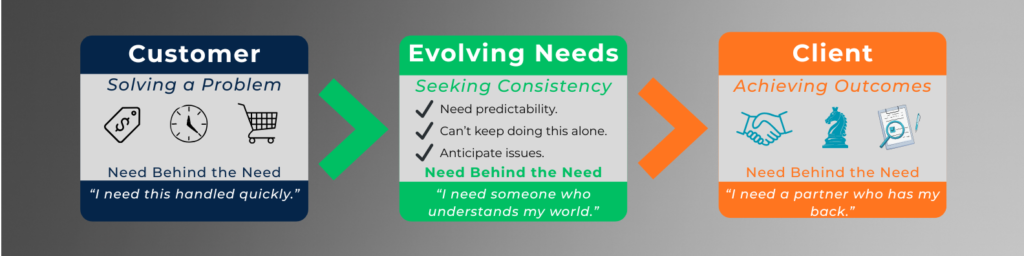
- “I just need this handled quickly.”
- “I don’t want to overthink this.”
- “I’m not ready to commit.”
- “I don’t want to involve anyone else.”
Customers aren’t “less valuable”. They’re simply solving a different kind of problem.
Where Repeat Customers Fit in the Buyer Journey
Repeat customers are the first signal that a deeper need is emerging.
They’re returning because you solved something well, but they’re still buying transactionally.
What’s happening in their world?
- They trust you/your product.
- They prefer you/your product.
- They’re starting to feel the pain of inconsistency or fragmentation.
- They’re repeating the same problem and want smoother solutions.
Characteristics of a Repeat Customer
- Comes back because the experience was strong
- Trusts your product or service
- Doesn’t require heavy nurturing
- Still buys transactionally
- Hasn’t committed to a long-term outcome or change
The Need Behind the Need
- “I don’t want to start over with someone new/this product/service fits my needs.”
- “I need this to be easier next time.”
- “I trust you more than the alternatives/changes are too costly.”
- “I’m starting to see patterns in my needs.”
Repeat customers are the bridge between transaction and partnership.
How Repeat Customers Differ From Clients
| Repeat Customer Returns for the product/service | Client Engages for the outcome |
| Loyalty earned through experience | Loyalty earned through partnership |
| Buys when they need something | Plans with you proactively |
| No long-term commitment | Ongoing engagement or retainer |
| You deliver to them | You work with them |
When a Repeat Customer is Ready to Become a Client
Their world is getting more complex.
They’re juggling more variables, more stakeholders, more risk.
Need behind the need: “I can’t keep managing this alone.”
They start asking for guidance, not just deliverables.
They want your thinking, not just your output.
Need behind the need: “I need someone who understands my context.”
They’re repeating the same problem and want consistency.
They’re tired of reinventing the wheel.
Need behind the need: “I need predictability.”
They want fewer vendors and more stability.
They’re consolidating relationships to reduce risk.
Need behind the need: “I need someone I can rely on.”
They’re involving you earlier in decisions.
They’re pulling you into planning, not just execution.
Need behind the need: “I need a partner who can anticipate what I can’t see.”
This is the moment to shift from customer mode to client mode.
The Long-Term Partner: What Defines a Client?
A client engages with you for outcomes, not transactions. They’re not buying a deliverable. They’re buying confidence, continuity, and strategic relief.
What’s happening in their world?
- They’re under pressure to deliver results.
- Their problems are interconnected.
- They need someone who understands their environment.
- They’re accountable to leadership.
- They can’t afford inconsistency.
Characteristics of a Client
- Relationship-driven
- Long-term engagement
- Higher trust and loyalty
- Focused on outcomes, not deliverables
- Sees you as a partner, not a vendor
The Need Behind the Need
- “I need someone who thinks with me.”
- “I need stability.”
- “I need a partner who helps me look good to leadership.”
- “I need someone who can anticipate issues before they occur.”
Clients aren’t buying your time. They are buying your thinking.
Why Both Customers and Clients Have Their Place
| Customers are ideal when: | Clients are ideal when: |
| Buyer’s need(s) is simple | Buyer’s world is complex |
| They want speed, not strategy | They need continuity |
| They’re minimizing commitment | They want outcomes, not tasks |
| They’re solving a one-off problem | They’re accountable for long-term results |
Healthy businesses have both. Smart businesses know which buyer is which and when the buyer is evolving.
Understanding the difference between a customer, a repeat customer, and a client isn’t about semantics — it’s about seeing the buyer’s world clearly. Each stage reflects a different level of complexity, risk, and emotional need.
And when you can recognize those shifts early, you stop treating every buyer the same. You stop overserving customers who aren’t ready. You stop underserving buyers who are ready. You stop leaving revenue — and relationships — on the table.
Most importantly, you start building a business that meets buyers where they are, not where you wish they were.
Part 2 picks up from here: How to intentionally guide buyers from transactional to strategic — and how to design offers, messaging, and delivery models that support the evolution.
If your buyers are evolving, your business model should too.
If you’re seeing signs that your customers are becoming repeat customers or that your repeat customers are ready for a deeper partnership —> this is the moment to shift from “doing work” to building a client engine.
That’s exactly what we help teams do.
Whether you’re:
- Moving upmarket,
- Redesigning your service tiers
- Clarifying your messaging
- Building a more predictable, client‑driven revenue model…
you don’t have to figure it out alone.
Let’s map your buyer journey, identify where you’re losing momentum, and build the systems that turn great work into long‑term partnerships.