
How Predictive Analytics Prioritize Prospects More Effectively
Funnels break when teams spend too much time guessing which leads matter. Clean data is the first fix (learn more about Why Funnels Break—and How AI Fixes Them), but once you have a healthier lead list, the next step is knowing which leads deserve attention right now. AI‑powered lead scoring changes the game by enabling predictive lead qualification and uses AI to separate noise from opportunity.
Traditional lead scoring relies on static rules (“+10 points for a webinar,” “+5 for company size,” “+3 for job title”). It’s simple, but it misses nuances required with today’s technology. This method treats signals as isolated events and assumes every action has the same meaning across every prospect.
AI changes that model. Instead of scoring based on assumptions, it enables scoring based on patterns, probabilities, and real conversion history. It learns what actually predicts revenue, not just what teams think predicts revenue. And honestly, the only method we previously had at our disposal without spending inordinate amounts of time crunching data.
Why Traditional Lead Scoring Falls Short
Traditional rule-based lead scoring systems worked well enough when data was limited and buyer journeys were simpler. However, today’s multi-channel engagement patterns require a scoring model that can interpret complexity, not just count actions.
With this in mind, even well built lead scoring systems struggle because they:
- Rely on historical conversion patterns. Rule based scoring freezes your assumptions in time. If life science buying behavior shifts because funding dries up, your rules won’t notice; even when conversion reality has changed dramatically.
- Overweight surface-level actions. A single whitepaper download (+10 points) can make a lead look “hot,” even though it’s a casual interest.
- Treat all signals equally. On paper, a newsletter open and whitepaper download (+20 points) look the same as a pricing page revisit (+20 points). In reality, the pricing-page visit shows real buying intent, while the weaker signals get overvalued.
- Miss cross-channel context. A prospect who attends two webinars and revisits the ROI calculator is showing a clear buying pattern. But because the signals aren’t connected into a journey, the scoring may fail to convey the right urgency to sales.
This is how static scoring creates false equivalence: casual interest, strong intent, and multi-channel engagement all end up looking identical.
How AI-Powered Lead Scoring Works
AI automates analysis at a scale and speed humans can’t replicate, recalibrating continuously as buyer behavior shifts.
Traditional scoring does not disappear. Instead, AI builds on the same inputs (downloads, opens, revisits) that rule-based systems use. In addition, it interprets them in context, weighting signals dynamically rather than freezing them in time. Think of traditional scoring as the baseline data, and AI as the intelligence layer that learns how those signals link with conversion.
However, AI can make mistakes, especially early on, or when data is incomplete. That’s why recalibration must be monitored and managed. Teams typically do this by:
- Setting guardrails and thresholds
- Auditing scoring and feedback loops
- Continuous iteration
AI lead scoring uses predictive analytics to evaluate leads based on likelihood to convert, not just activity. It analyzes thousands of data points across four categories:
1. Behavioral Patterns
AI doesn’t look at single actions; it looks at sequences like multiple pricing‑page visits and case study downloads after product page views. These patterns matter more than any one action. AI identifies them automatically.
2. Firmographic & Technographic Fit
AI evaluates whether a lead matches your Ideal Customer Profile (ICP) based on:
- Company size
- Industry
- Revenue
- Tech stack
- Growth indicators
Instead of “they downloaded a guide,” AI can determine “this company looks exactly like the last 12 deals you closed.”
3. Historical Conversion Data
This is the real power, but also where caution is needed.
AI learns from your actual wins and losses:
- Which companies convert fastest
- Which job titles respond to outreach
- Which engagement paths lead to revenue
- Which signals correlate with churn
It scores leads based on what has actually worked, not what teams assume works. Still, conversion data reflects outcomes, not every underlying reason. External factors like a brand perception or sales relationships can skew results. That’s why recalibration must be monitored and managed, with human oversight ensuring the scoring logic stays aligned with reality.
4. Buyer Role Identification
AI can identify whether the form-filler is:
- A decision maker
- An influencer
- A researcher
If a “Marketing Coordinator” downloads a guide, AI can surface the “VP of Marketing” automatically. This accelerates sales outreach and reduces time wasted on non-buyers.
What Predictive Lead Scoring Enables
Once AI scores leads based on conversion likelihood, teams unlock three major advantages:
1. Prioritization That Mirrors Reality
Sales focuses on leads that:
- Looks like past wins
- Show real intent
- Match ICP
- Engage in meaningful patterns
This reduces wasted effort and increases conversion velocity.
2. Real-Time Sales Alerts With Context
Instead of “a lead visited the site,” AI provides:
- “This lead revisited pricing three times in 48 hours.”
- “This account matches your highest-converting segment.”
- “This prospect’s engagement pattern mirrors your last 10 closed-won deals.”
Context drives urgency and urgency drives revenue.
3. Smarter Sales & Marketing Alignment
AI creates a shared scoring model both teams trust. Marketing sees which leads are truly qualified and sales sees WHY leads are prioritized… eliminating the “your leads aren’t qualified” debate entirely.
The Real Outcome: A Funnel That Moves Faster
Predictive scoring isn’t replacing traditional methods; it’s enhancing them with the intelligence teams never had access to before. Rule-based inputs like downloads, opens, and revisits still matter, but AI interprets them in context and prioritizes leads based on what actually drives revenue.
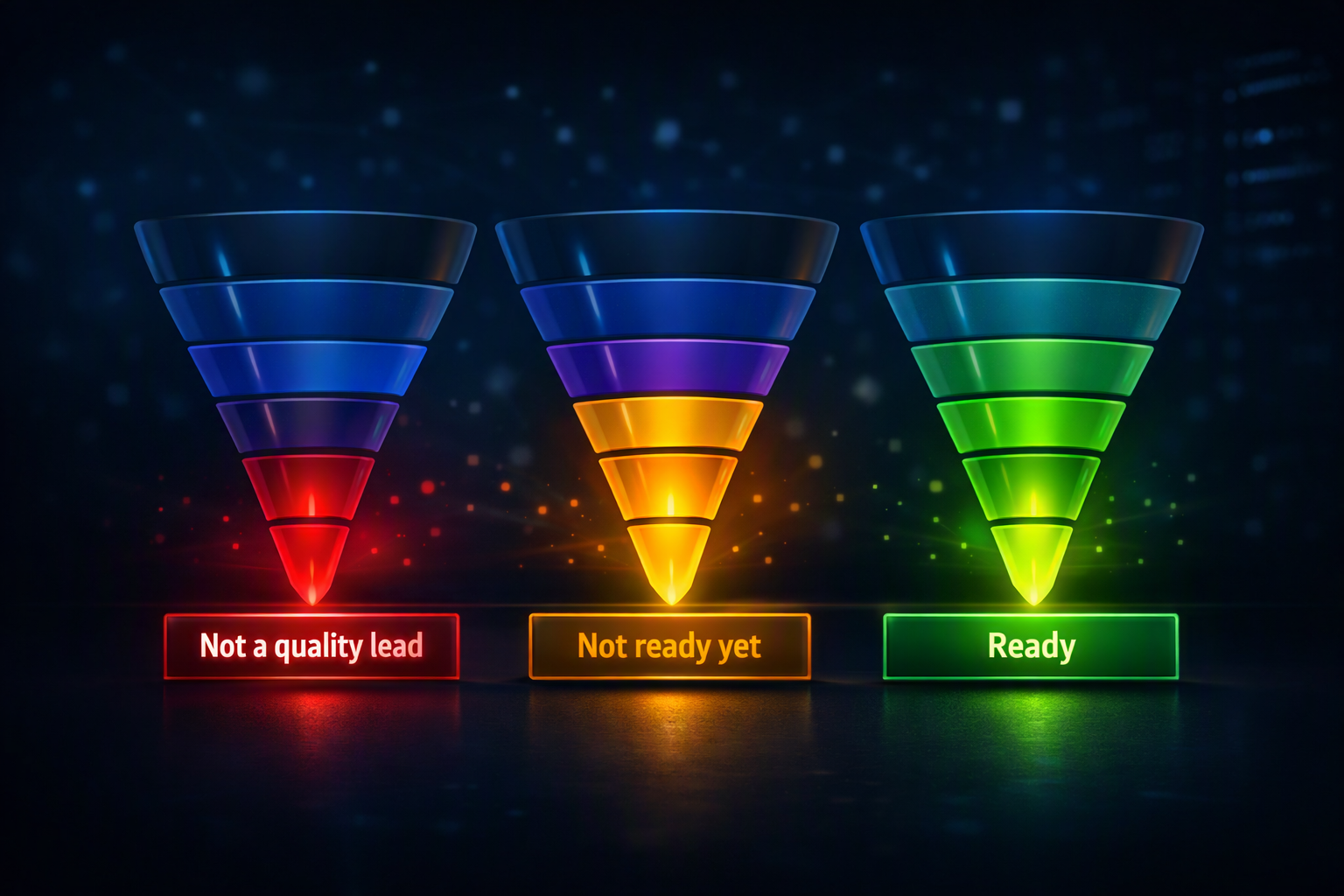
AI-powered scoring accelerates the funnel.
- High-scoring leads get faster outreach.
- Mid-scoring leads get targeted nurture.
- Low-scoring leads don’t clog the funnel.
CLSC Helps You Implement Predictive Lead Scoring
CLSC Strategic Consulting helps you make predictive scoring practical by focusing on the marketing and sales side of adoption. We don’t build the AI models, we help your teams use them effectively.
We partner with you to:
- Audit your current scoring model. Identify gaps and assumptions in your existing rules.
- Identify the signals that actually matter. Highlight behaviors and attributes that correlate with conversion.
- Build shared dashboards. Create visibility for both sales and marketing.
- Train teams on AI insights. Help teams interpret scores and act on them confidently.
- Create nurture paths. Design campaigns for mid-scoring leads that need more engagement.
- Align scoring with ICP and revenue goals. Connect predictive scoring to your ideal customer profile and revenue strategy.
We make AI practical, not theoretical—ensuring your scoring model reflects your business, your buyers, and your real conversion patterns.
If you’re ready to align scoring with your buyers and revenue goals, let’s talk.
Looking for more marketing insights? Read our previous blogs:
Customer vs. Client: Why the Difference Matters More Than You Think (Part 1)
Customer vs. Client: Why the Difference Matters More Than You Think (Part 2)
Bridging Requirements and Client Messaging: The Strategic Core of Product Management
DISCLAIMER: CLSC Strategic Consulting does not sell AI software. We help you identify where implementing AI-driven processes can improve results, and assist in evaluating, adapting, and integrating the right solutions into your organization.