
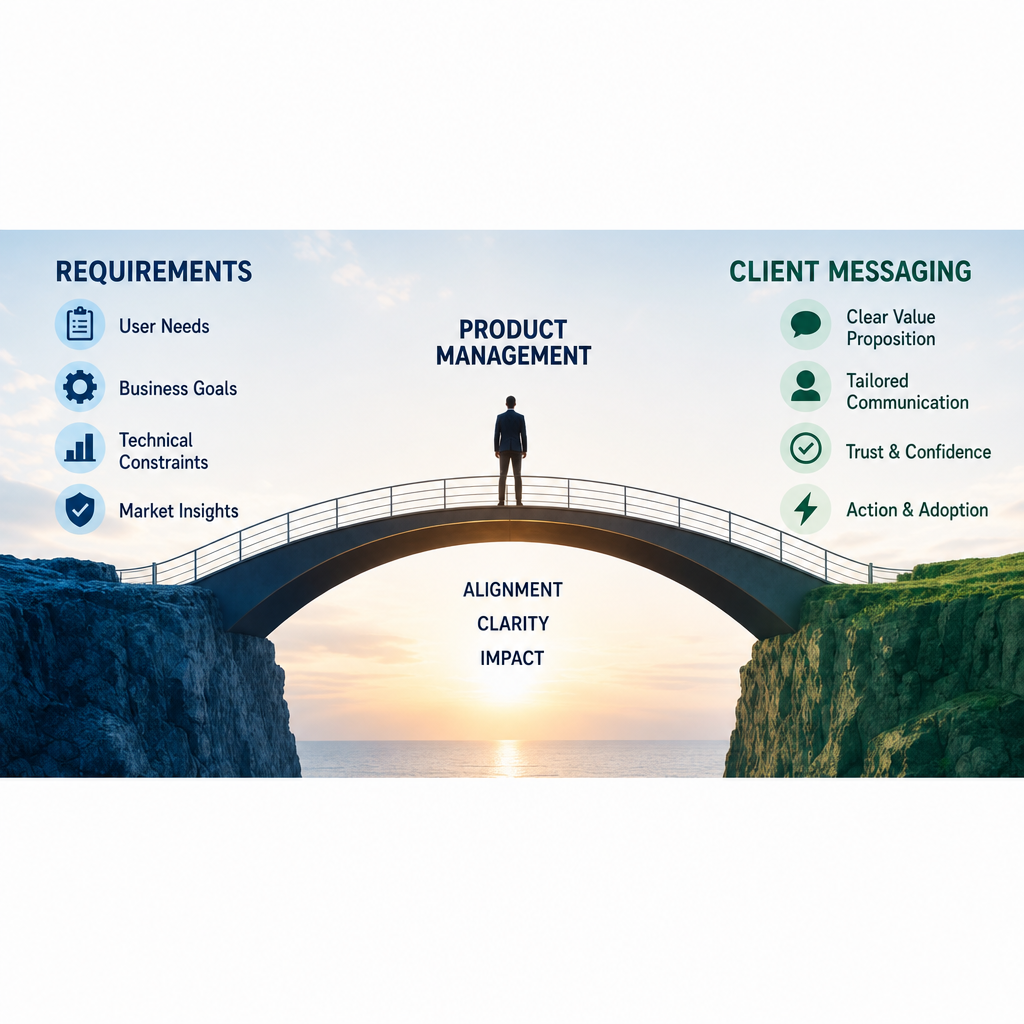
The biggest gap in most product organizations isn’t strategy or execution—it’s the space between requirements and how we translate them into solutions that address clients’ unmet needs. That gap quietly determines which products thrive and which ones stall.
Requirements as Raw Inputs and Why They’re Never Enough
Requirements rarely show up as clean, actionable statements. They arrive as:
- Feature requests
- Pain points and complaints
- “Nice to haves”
- Sales escalations
- Market trends
- Competitor offerings
- Technical constraints
They’re outputs of everything happening around the product: client needs, market pressure, internal priorities, and technical realities.
But a requirement on its own doesn’t tell you whether it actually:
- Solves a real unmet need
- Is technically feasible
- Is cost-appropriate
- Aligns with the product strategy
- Supports the company’s direction
- Is worth prioritizing now versus later
That’s the PM’s job: To evaluate each requirement through the lens of value, feasibility, and strategic fit.
Gathering Requirements the Right Way
Beyond the Checkbox
Most teams collect requirements. Strong PMs extract them.
That means:
- Asking “What problem does this solve?”
- Checking whether the problem is real, recurring, and meaningful
- Understanding the workflow behind the request
- Distinguishing between a symptom and the root cause
- Looking for patterns across clients, segments, and use cases
This is where unmet needs start to surface—usually hiding beneath the stated request.
Identifying the True Unmet Needs
This is the heart of product management.
Unmet needs are the problems that clients feel, but don’t always articulate. Let’s be honest—they rarely articulate them clearly, and you have to dig for them.
Instead, they show up as:
- Workarounds
- Repeated questions
- Low adoption
- High support needs
And once you see those patterns, you can identify the actual problem the client has—not just the request they submitted.
Internal Alignment: Building a Shared Understanding
Before development moves forward, the PM ensures alignment across:
- Engineering / R&D
- Clinical / Medical Affairs / Regulatory
- Design
- Sales
- Leadership
- Downstream and regional marketing
- KOLs (where appropriate)
Alignment isn’t a meeting. It’s a shared understanding of:
- The unmet need
- The problem being solved
- The value being delivered
- The constraints that matter
- The risks to be managed
- The cross-functional agreement
This alignment keeps the development process focused, consistent, and grounded in solving the real problem.
Translating Requirements Into Value-Driven Language
Clients don’t buy features. They buy relief, clarity, speed, accuracy, compliance, confidence…
The PM reframes technical requirements into:
- The problem being solved
- The outcome being unlocked
- The friction being removed
- The measurable benefit
This translation is the bridge between internal truth and external understanding.
Bringing in Downstream Marketing: Early, Not at the End
If your organization separates product management and marketing, this is where the partnership becomes essential.
The PM hands marketing:
- The unmet need
- The validated problem
- The value narrative
- The user language
- The constraints
- The differentiators
Marketing turns this into:
- Positioning
- Messaging frameworks
- Campaign narratives
- Competitor battlecards
- Channel-specific assets
- Commercial training
The PM provides the form, function, and proof points. Marketing provides the clarity and the right vehicle to amplify the message.
Together, they ensure that internal teams know how to speak about the solution and clients can clearly see how their pain point is being solved.
Ensuring Client-Facing Messaging Supports the Unmet Need
This is the final, and often missing, step.
Client messaging must reinforce the unmet need the product solves. It must highlight outcomes, not features. And it must make the value obvious, not implied.
When messaging aligns with unmet need solutions, adoption increases, support needs decrease, clients feel understood, and sales conversion rates improve.
Messaging becomes a strategic asset, not an afterthought.
Closing the Loop
Bridging requirements and client messaging isn’t a linear process. It’s a strategic loop that ensures:
- You build the right thing
- You communicate it clearly
- Clients and your commercial team understand the value
- The organization stays aligned
When PMs and marketers operate as partners, products don’t just ship… they succeed.
See how CLSC improves client messaging from customer-centric to client focused. Read our previous blogs: