
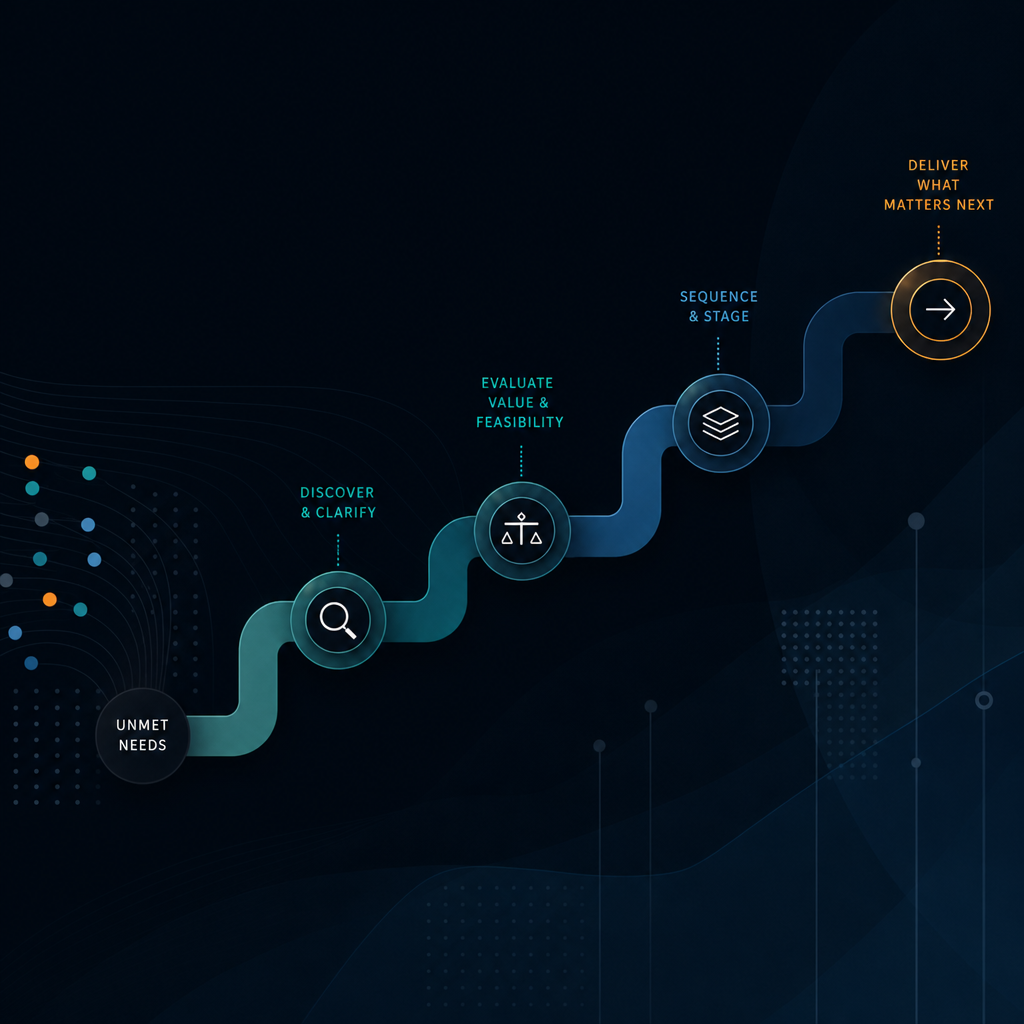
In our last blog (Bridging Requirements and Client Messaging: The Strategic Core of Product Management) we focused on identifying how to use clients’ unmet needs to build your products requirements and linking this to the downstream messaging. Identifying the unmet need is only the beginning.
The harder, more strategic work is deciding what to build now, what to build next, and what to build only when the timing, evidence, or architecture makes it feasible.
Every product team wants to deliver the full vision. But real-world constraints (cost, complexity, evidence, integration, regulatory) force PMs to make decisions that protect both the product and the business.
This is where the product development pipeline becomes a discipline, not a wish list.
The Pipeline Is a Series of Strategic Tradeoffs
Once you know the unmet need, the question becomes: What is the smallest, most valuable, most feasible version of the solution we can deliver first: one that creates momentum, reduces risk, and starts generating revenue?
This is where PMs evaluate:
- Cost vs. value
- Time vs. impact
- Complexity vs. adoption
- Evidence required vs. evidence available
- Engineering capacity and capability vs business urgency
- Integration dependencies vs. client workflows
This is when PMs stop being requirement collectors and start being portfolio strategists.
Think: Roadmap Staging, Dependency Sequencing, and Foundational vs. Differentiating Features
Breaking Big Needs Into Sequenced, Buildable Steps
Some unmet needs are too large to solve in one release. Smart PMs break these into logical, value-delivering increments.
For example:
- Enable basic workflow support
- Add automation
- Layer in intelligence (may include AI)
- Integrate with external systems
- Deliver predictive or advanced capabilities
Each step solves part of the unmet need while building toward the full vision. This sequencing protects the team from overcommitting and the business from overinvesting too early. It eliminates “all or nothing” thinking.
Think: Incremental Value Delivery and Minimum Viable Product/Workflow
When Constraints Shape The Roadmap
PMs operate inside constraints that clients never see including engineering bandwidth, architecture limitations, regulatory requirements, data availability, integration readiness, market timing, budget, and internal business competition for resources.
The art is not ignoring constraints. It’s designing a roadmap that works with them instead of fighting them.
Think: Constraint-Driven Prioritization and Dependency Mapping
The Pipeline as a Living System
A strong product development pipeline is dynamic, evidence-informed, sequenced, prioritized, realistic, market-aligned, and capacity-aware. It evolves as:
- New client signals emerge
- Adoption patterns shift
- Capabilities expand
- Costs change
- Competitor threats intensify
- Markets shift
- Regulations change
- And more
PMs need to move from managing a backlog to orchestrating a product system.
Think: Dynamic Roadmapping, Signal-Driven Iteration, and Competitor Response Planning
The Real Work of the PM
Translating unmet needs into requirements is important. But translating requirements into a sequenced, feasible, strategically staged product pipeline is where PMs create real value.
This is the work that:
- Builds trust with clients and your internal development team
- Reduces rework
- Manages expectations
- Accelerates delivery
- Aligns the organization
- Turns vision into reality
And it’s the work most organizations don’t teach PMs how to do.
This is where CLSC can help you – in the translation layer between what clients need and what the business can deliver next.