
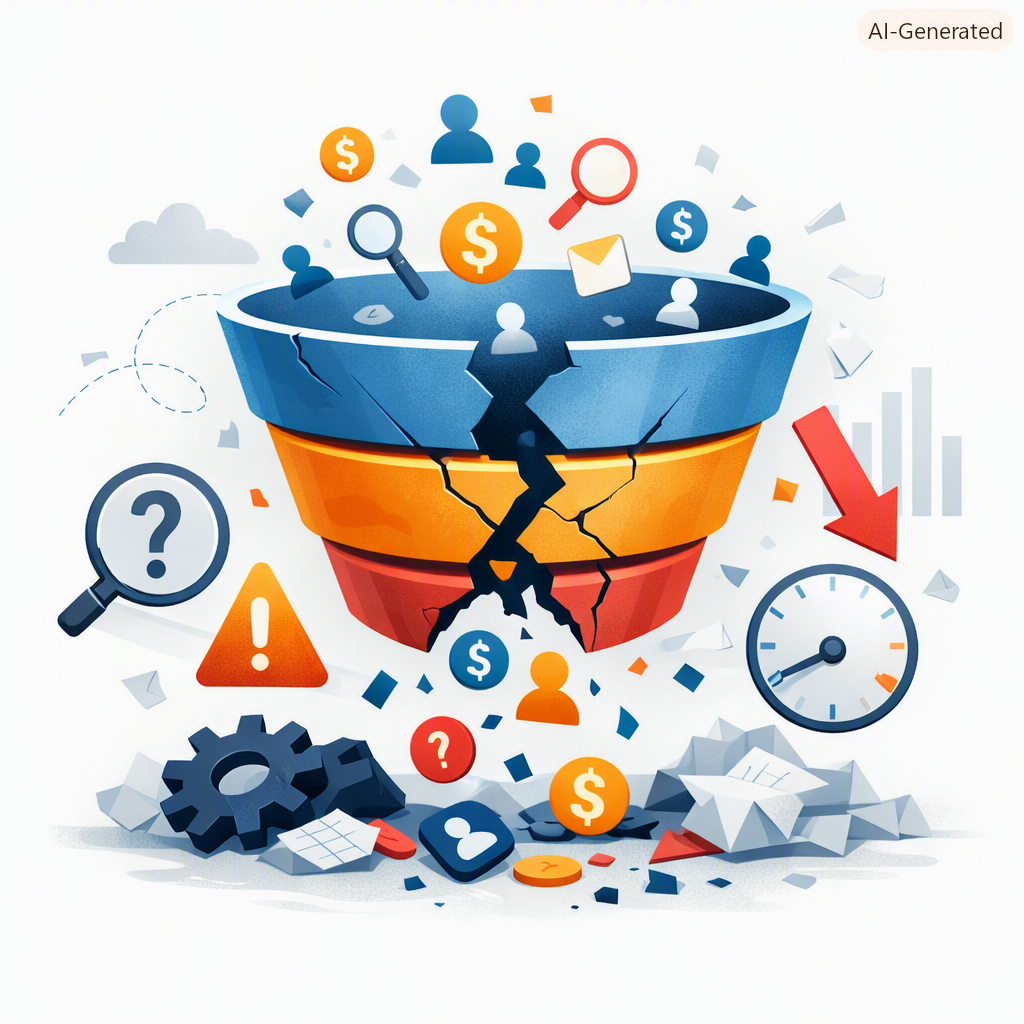
The Funnel Problem
Funnels break when they fill up with the wrong leads and AI fixes them by helping teams qualify smarter and act faster. Marketing funnels are designed to guide prospects from awareness to conversion, but in practice they often fill up with leads that aren’t good fits or aren’t real opportunities. Teams then spend significant time weeding out unqualified leads to find the ones worth passing to sales—the marketing qualified leads (MQLs) that truly matter.
Even after qualification, leads frequently stall in the funnel. They lose momentum or need additional persuasion (data, testimonials, case studies, etc.) to move forward. This is where sales enablement content and persuasion tactics become critical to keep prospects engaged and progressing.
Without a structured way to prioritize and nurture, funnels quickly become inefficient, turning into bottlenecks that slow growth instead of driving it.
Common Issues In The Funnel
Even when the funnel is working, it can be hard to convert prospects efficiently. These challenges fall into two main categories: lead quality and volume, and internal sales delays and understanding.
Lead Quality & Volume
- Unqualified Leads. While marketing generates volume, many leads aren’t real opportunities or a fit for what you are selling.
- Too Many Leads. Having too may leads is problematic when sales can’t follow up on them all.
- Low Conversion Rates. Treating all leads equally wastes time on poor fits.
- Wrong Contact. The person who fills out your form or downloads your content isn’t always the ultimate buyer. Sales teams must identify and reach the true decision maker, which slows down the funnel.
Internal Sales Delays & Understanding
- Lead Stalling. Even qualified leads lose momentum or need more persuasion before moving forward.
- Misalignment Between Marketing and Sales. Disagreement over what counts as “qualified” creates friction and wasted effort.
- Delayed Response Times. Even the most qualified lead can fail to move forward in the funnel if there’s a delay before sales engages.
How AI (Helps To) Fixes The Funnel
AI transforms how funnels operate by tackling the root problems directly.
CLSC helps you identify and implement the right approach for your business
Lead Quality & Volume
- Smarter Qualification. AI tools can quickly filter out unqualified leads by analyzing multiple data points beyond the form fill—such as firmographics (company size, industry, revenue), technographics (tools they use), and engagement history. Instead of just “they downloaded a whitepaper,” AI can flag whether the company matches your ICP (ideal customer profile) and whether similar accounts have converted before.
- Predictive Prioritization. AI ranks leads by conversion likelihood, helping sales focus on the best opportunities instead of drowning in volume. It learns from historical conversion data to predict which leads are most likely to move forward. For example, it can identify that leads from mid market healthcare firms with repeat webinar attendance tend to convert at higher rates, and automatically rank them higher.
- Intent Recognition. AI interprets behavioral signals to spot genuine interest—not from a single action, but from patterns of engagement over time. Someone who attends multiple webinars, revisits pricing pages, and downloads case studies is showing stronger buying intent than someone who just stopped by your booth once. By connecting signals across channels (site visits, email opens, ad clicks, event attendance), AI distinguishes casual interest from genuine purchase intent.
- Buyer Identification. AI cross references job titles, LinkedIn data, and organizational hierarchies to identify whether the form-filler is a decision maker, influencer, or researcher. If it spots “Marketing Coordinator” filling out a form, it can flag that the real buyer is probably the “VP of Marketing”—and surface that contact from available data sources. This helps sales reach the right person faster, even if the initial lead came from someone lower in the organization.
Internal Sales Delays & Understanding
- Real-time Alerts. AI doesn’t just ping sales when a lead takes an action—platforms like HubSpot and Salesforce already do that. The difference is that AI adds context. Instead of “a lead visited the site,” it can flag why that matters. e.g., “this lead revisited the pricing page three times in 48 hours.” That helps sales prioritize outreach based on urgency and buying signals, not just activity.
- Sales Enablement Insights. AI suggests the right content to move stalled leads forward—case studies, testimonials, ROI calculators, or data sheets tailored to the lead’s stage. Importantly, this isn’t only for sales. AI can also trigger marketing when a tactic is needed. For example, if a segment of leads consistently stalls after webinar attendance, AI can recommend a nurture campaign with customer success stories. This dual enablement ensures both sales and marketing act in sync to keep leads progressing.
- Alignment Through Shared Data. AI creates a common, data driven view of lead quality. Instead of marketing and sales debating what counts as “qualified,” both teams see the same signals and scoring logic. That shared foundation reduces friction and builds trust, so handoffs are smoother and pipelines more reliable.
Closing Thoughts
Funnels break because they’re overloaded with the wrong leads, slowed down by stalled prospects, and strained by misalignment between marketing and sales. AI can help to fix these problems by tackling them directly: qualifying smarter, prioritizing better, interpreting engagement patterns, and helping both teams act in sync.
From diagnosing where your funnel is breaking to advising on AI-driven strategies and helping you integrate the right solutions into your existing systems to improve qualification, prioritization, and alignment, CLSC Strategic Consulting partners with you to turn bottlenecks into growth engines.
We help you to apply these AI principles in practical, tailored ways ensuring your funnel moves forward with clarity, confidence, and results.
Looking for more marketing insights? Read our previous blogs:
Customer vs. Client: Why the Difference Matters More Than You Think (Part 1)
Customer vs. Client: Why the Difference Matters More Than You Think (Part 2)
Bridging Requirements and Client Messaging: The Strategic Core of Product Management
DISCLAIMER: CLSC Strategic Consulting does not sell AI software. We help you identify where implementing AI-driven processes can improve results, and assist in evaluating, adapting, and integrating the right solutions into your organization.