
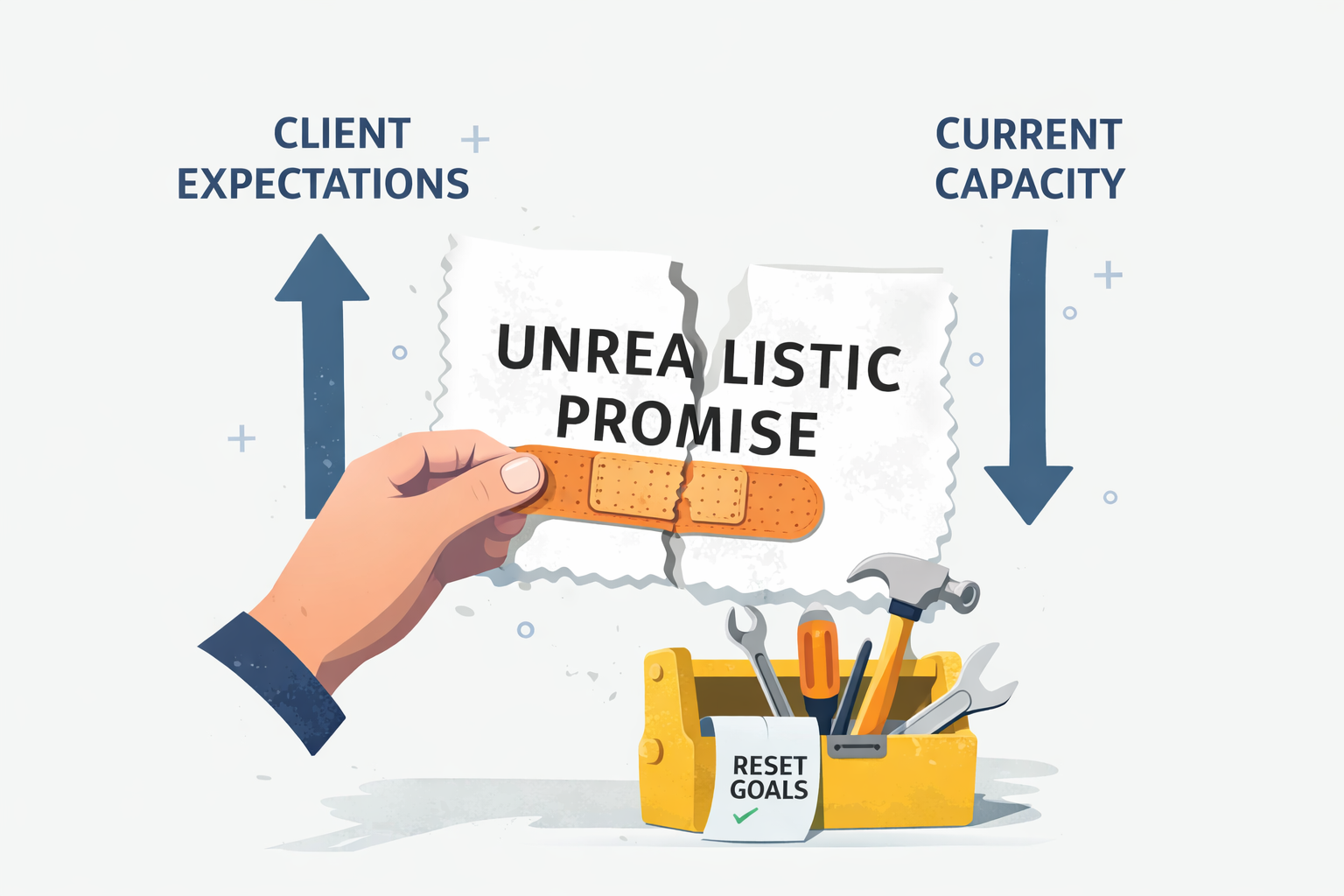
When A Product Manager or Other Team Member Provides Unrealistic Dates to Clients
There’s a special kind of dread that hits a leader’s stomach when they hear a Product Manager, Sales Rep, or Business Development Manager, etc. confidently tell a client, “Yes, we can deliver that by next quarter,” when you know with absolute certainty that there’s no universe where that date is achievable.
It’s not just a bad date. It’s a credibility issue and potentially a future lost client.
But here’s the truth most leaders don’t want to admit:
Unrealistic dates are a leadership and system problem.
When someone on your team over-promises, it’s a signal, not a character flaw. Your job is to decode the signal and fix the system that allowed this to happen.
Let’s break down the playbook.
Diagnose the Root Cause Before You Correct the Behavior
When someone on your team gives an unrealistic date, the first instinct is to immediately correct the behavior. “Don’t commit to timelines without checking with the development team/project manager.” But that’s treating the symptom, not the system.
Over-promising almost always has a deeper cause. Your job as a leader is to diagnose the root cause before you attempt to fix anything.
Here are the most common drivers:
- Pressure from Sales or Business Development. When revenue is on the line, teams feel compelled to “just give them something”.
- Senior Leadership revenue expectations. When the company is hyper-focused on the bottom line (quarterly targets, investor updates, board pressure) teams downstream feel the urgency. This can lead to over-promises not because teams are reckless, but because they’re trying to align with leadership’s objectives: growth at all costs, speed above accuracy.
- Lack of a clear roadmap or sequencing discipline. If priorities aren’t clear or stable, people fill the gaps with guesses.
- Fear of disappointing a client. Some team members would rather give a date than risk appearing unhelpful.
- A culture that rewards speed. If the organization celebrates “momentum” more than accuracy, over-promising becomes normalized.
- No shared definition of what “commit-ready” means. Without alignment on what constitutes a real date, people create their own rules.
Each of these is a system signal, not an individual failure. Your job is to understand why they felt the need to over-promise. Identify the underlying driver, and the solution becomes clearer and easier to implement.
Reset the Communication Contract—Internally and Externally
Once you’ve diagnosed why the over-promise happened, the next step is to reset the communication contract—not just inside your team, but with your clients as well. Unrealistic dates don’t live in a vacuum. They shape expectations, influence planning, and create a version of reality that your team is now forced to chase.
Don’t make the mistake of only correcting the internal team and leaving the client expectation untouched!
Resetting the Internal Contract
Internally, the rule is simple:
No one person owns the delivery date. The team does.
A product manager, sales rep, or business development manager can frame the problem, the value, and the urgency, but they cannot commit the organization to a timeline.
Resetting the internal contract means:
- Dates come from cross-functional alignment and project plans with risk built in
- Development teams validate feasibility
- Commercial teams communicate ranges, not promises
- Leaders reinforce quality over speed, even when revenue pressure is high
This is how you build a culture correction.
Resetting the External Contract (Client Expectations)
Even if you fix the internal behavior, the client is still planning around an unrealistic date they were given.
You must address that—quickly and professionally.
A clean reset sounds like:
“We’re reviewing the request you shared with our team and aligning the delivery with a detailed project plan. We’ll follow up with a committed timeline once the full team completes the scoping review.”
This does three things:
- Reclaims control of the narrative
- Protects your team from unrealistic pressures
- Rebuilds trust without throwing anyone under the bus
Plus, it’s crucial to building long-term credibility with clients.
And Sometimes… It Is a Capability Problem
While most over-promising is systematic, not all of it is.
Sometimes the person giving unrealistic dates is:
- A bad hire
- Someone promoted too quickly
- Someone placed into a role without the right training
- Someone who doesn’t understand delivery complexity
- Someone who confuses confidence with competence
When that’s the case, the leadership responsibility shifts to:
- Clarifying expectations
- Providing targeted coaching
- Giving them the tools and frameworks they’re missing
- Assessing whether they can meet the job requirements with support
If they can’t meet the job requirements—you have a different decision to make.
Wrapping Up Part 1: Fix the System, Protect the Team, Preserve Trust
Over-promising isn’t a one-off mistake—it’s a signal. As leaders, our job is to interpret that signal, fix the conditions that created it, and protect both our teams and our clients from the downstream consequences.
Part 1 of this playbook focused on the foundational moves:
- Diagnose the real cause, not just the behavior
- Reset the communication contract internally and externally
- Recognize when the issue is capability, not process
These steps alone will dramatically reduce the frequency and outcome severity of unrealistic commitments. But they’re only the beginning.
Because once you’ve stabilized the system and reset expectations, the next challenge emerges:
How do you rebuild trust, repair credibility, and create a culture where accurate commitments become the norm and not the exception?
Once you’ve fixed the system, the next challenge isn’t technical—it’s relational. That’s where Part 2 comes in.
Coming in Part 2: Focus on Rebuilding Trust
Now that you’ve stabilized the system and reset expectations, the next challenge emerges:
How do you rebuild trust with clients, with sales, and inside your organization after an unrealistic date has already been shared?
Part 2 will go deeper into:
- How to rebuild trust with clients and Sales
- How to reset expectations without blame
- How to communicate revised timelines with confidence
- How to prevent credibility debt from compounding
Part 2 is all about repairing and strengthening—the work that turns a reactive team into a trusted, predictable partner.
Closing Thought
Strong leadership isn’t about preventing every misstep—it’s about creating the conditions where your teams can make accurate commitments, protect credibility, and deliver with confidence.
If you or your team needs support building the alignment, communication habits, and operating discipline that prevent over-promising, CLSC can help—through training, facilitation, or fractional product leadership.