
From Heroics to Habits: Agility In Motion
There’s a moment that happens after the crisis is over—after the date is corrected, the plan is aligned, and the client relationship is back on steady ground. The immediate issue is resolved, but the underlying conditions that allowed it (the over‑promise) to happen still exist.
This is where strong teams turn to process improvement, not heroics.
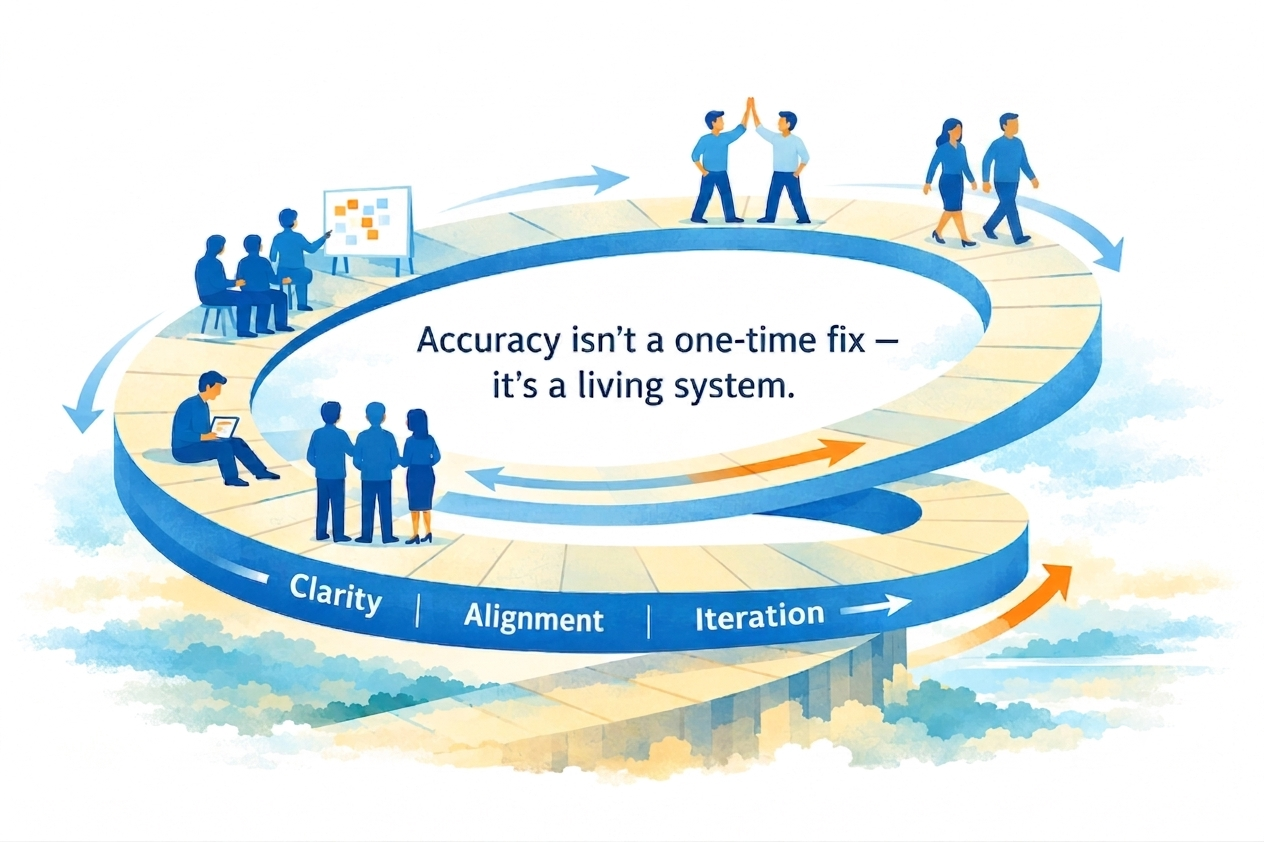
In Agile environments, accuracy isn’t a one‑time correction: it’s the outcome of continuous inspection and adaptation. When over‑promising shows up, it’s a signal that the team’s operating system needs adjustments: clearer intake, tighter alignment, better definition of “ready,” or more reliable forecasting loops.
Part 3 is about that work.
How leaders use Agile principles (transparency, cadence, iteration, and shared ownership) to build a delivery system where commitments are grounded, communication is consistent, and accuracy becomes the natural byproduct of how the team operates.
Because sustainable credibility doesn’t come from correcting mistakes. It comes from improving the system so the same mistake doesn’t repeat.
Operationalizing Accuracy
Most organizations don’t struggle because people are careless. They struggle because their operating system leaves too much room for interpretation. The intake process isn’t clear. Capacity is assumed to be available. Dependencies are not captured. In this state of ambiguity, over‑promising thrives.
Operationalizing accuracy means tightening those gaps through short, reliable feedback loops that catch misalignment early and keep teams working from the same place.
Accuracy becomes operational when teams anchor their work in shared definitions and predictable loops. In Agile terms, that means reinforcing the basics:
- Clear intake criteria. Preventing half-formed work from entering the system.
- Cross‑functional alignment loops. Ensuring every function is planning from the same truth.
- Capacity-driven forecasting. Grounding commitments in what the team can actually deliver.
- Shared “ready” and “done” standards. Eliminating ambiguity before it becomes a promise.
These loops don’t slow teams down. They stabilize them. They create the conditions where dates are based on facts and where accuracy becomes a natural output of the system, not something leaders have to enforce manually.
Without this foundation, the next step cannot succeed.
Leadership Behaviors That Reinforce Credibility
Systems and processes create the structure for accuracy, but it’s leadership behavior that makes those structures stick. When leaders model clarity, consistency, and disciplined communication, teams follow. When they don’t, even the best operating system erodes, especially when the team is under pressure.
Three leadership behaviors matter most.
- Clarity before commitment. Leaders slow the conversation down long enough to ensure the team has the information, scope, and constraints needed to make a grounded commitment. They don’t reward speed at the expense of accuracy.
- Transparency under pressure. When timelines tighten or assumptions shift, leaders ensure early visibility of the issues, capacity, and capability available for the project. They normalize proactive risk mitigation, ensuring issues are addressed before they turn into surprises.
- Consistency in follow-through. Leaders reinforce the operating system by using it themselves: the same intake criteria, the same alignment loops, the same capacity‑based forecasting. Consistency signals that accuracy isn’t optional—it’s cultural.
These behaviors do more than support the process. They create an environment where teams feel safe to be honest about constraints, confident in how decisions are made, and aligned around what “good” looks like. That’s how credibility becomes sustainable; not through heroics, but through disciplined, repeatable leadership habits.
Systems That Protect Credibility
Leadership behaviors set the tone, but systems are what make actions repeatable. When the operating system is clear, consistent, and visible, teams don’t have to rely on memory, heroics, or individual judgment to stay aligned. The system does this for them.
Strong organizations build systems that reduce ambiguity at the source and make it easier to do the right thing than the fast thing. Four elements matter most:
- Shared definitions of “ready”. Work only enters the system when scope, constraints, and dependencies are understood. This prevents premature commitments and ensures assumptions never make their way into the decision‑making process.
- Cross-functional review gates. Not phase‑gate reviews, but quick, team‑driven feasibility checks. This does not cover the entire work breakdown, but just enough clarity to confirm the date is grounded and not aspirational.
- Capacity-based forecasting tools. Clients want to know the left hand and right hand are talking. These tools make alignment visible by showing that the full team understands the plan, the constraints, and what it will take to deliver.
- Decision frameworks that prevent “just say yes” culture. Clear criteria for when to commit, when to defer, and when to escalate. These frameworks protect accuracy by ensuring commitments are made intentionally, not reactively.
When these systems are in place, accuracy stops being dependent on who’s in the room. It becomes part of how the organization operates. They ensure predictability, consistency, and resilience.
Sustaining Accuracy Through Leadership and Systems
When leaders model clarity and the operating system supports it, accuracy stops being something teams have to fight for. It becomes the natural outcome of how work moves through the organization. Teams know what “ready” looks like. They understand how commitments are made. They see how decisions are evaluated. And they trust that the system will hold, no matter the internal or external pressures.
This is where credibility takes root. Not in the moments when everything is calm, but in the moments when timelines tighten, priorities shift, or new information emerges. Organizations that protect accuracy in those moments build a culture where teams don’t default to optimism, avoidance, or silent assumptions. They default to alignment, transparency, and grounded decision‑making.
That’s the shift Part 3 is driving toward: moving from reactive promises to a predictable operating rhythm where accuracy is supported by leadership behavior and reinforced by the system itself. When those two elements work together, teams deliver with confidence—and leaders don’t have to rely on heroics to maintain trust.
Part 1 was about recognizing the root cause behind the over-promise and beginning the internal and external reset.
Part 2 was about strengthening the relationship after an over‑promise.
Part 3 shifted the focus to building the internal habits, systems, and leadership behaviors that make accuracy the default—not the exception.
Closing Thought
Accuracy doesn’t come from pushing teams harder… it comes from leaders who create the environment where teams can deliver reliably. By modeling clarity, reinforcing the operating system, and grounding commitments in facts, leaders give teams the confidence and structure they need to deliver even when pressure rises.
If you (or your team) need support building the systems, habits, and leadership behaviors that protect credibility and make accuracy sustainable, CLSC can help—through training, facilitation, or fractional product leadership.